Vardzia is the most famous cave town in Georgia: about 600 rooms carved into a sheer cliff above the Kura River back in the 12th century. Queen Tamar prayed here, and monks still live in the caves today. Crowds are rare, since Vardzia sits too far off the main routes for a casual stop. Here is what to see in the rock-cut town, how much tickets cost in 2026 and how to get there from Tbilisi, Batumi or Akhaltsikhe.
Table of contents
What Is Vardzia
The cave monastery complex sits in the Samtskhe-Javakheti region in southern Georgia, about 70 km from Akhaltsikhe and 270 km from Tbilisi. Roughly 600 surviving rooms are cut into the tuff cliff on 13 levels: churches, cells, refectories, storerooms, wine cellars, stables and even a pharmacy. The complex stretches for almost 500 meters along the rock face and goes dozens of meters deep into the stone.
What sets Vardzia apart from museum-type sights is that it is alive. Since 1988 a monastery has been active here again: monks live in the caves, and services are held in the Church of the Dormition. In 2021 the Vardzia conservation project received an EU cultural heritage award, and the complex is on UNESCO's tentative list.
History: From Hidden Fortress to Monastery
Construction began under King Giorgi III in the second half of the 12th century: the fortress was meant to shield the border from the Seljuks. His daughter, Queen Tamar, turned it into a monastery that became the spiritual center of Georgia's Golden Age. Chronicles say the shelters of Vardzia could hide tens of thousands of people. From the outside the town stayed nearly invisible, its entrances hidden in the folds of the cliff.
Everything changed with the earthquake of 1283. The cliff collapsed and sheared off the outer layer of rock, leaving the secret town exposed like a cutaway house on an architect's model. That is why the caves are visible from outside today. In 1551 Vardzia was sacked by the Persians of Shah Tahmasp, the region later fell to the Ottomans, and the monastery stood empty for a long time. Restoration work began in the 19th and 20th centuries, and monastic life returned in the late 1980s.
According to legend, the name appeared when young Tamar got lost in the caves and answered her uncle's call with "Ak var, dzia!", meaning "I am here, uncle". A lovely story, though linguists still argue about it.
What to See Inside the Cave Town
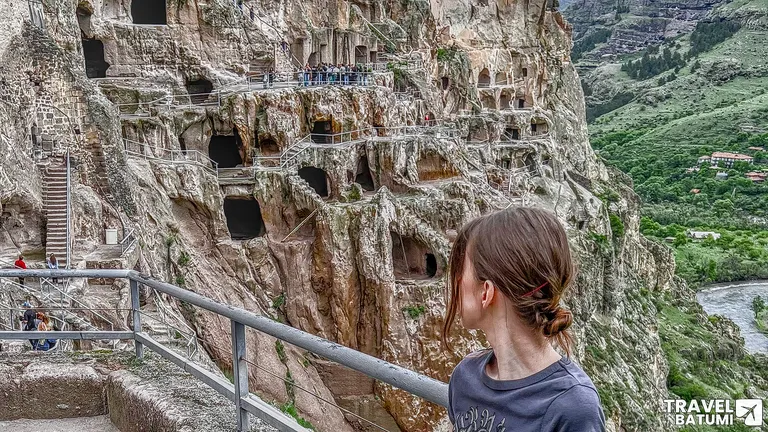
Set aside 1.5-3 hours. The route runs along cleared levels connected by stairs and tunnels. In places you will need to duck and climb steep steps inside the rock: the tunnels stay cool even in July heat and smell of damp stone.
- The Church of the Dormition - the heart of Vardzia. It preserves frescoes from 1184-1186, including portraits of Giorgi III and Queen Tamar made in their lifetimes, a rare case in Georgian art.
- The Tears of Tamar spring deep inside the cliff. A narrow tunnel leads to it, the water is considered healing, and the monks still draw it today.
- Wine cellars with sockets for qvevri, the clay wine vessels that once sat right in the floor.
- A pharmacy with stone shelves for herbs and a refectory where the long tables are cut from solid rock.
- The 13th-century bell tower, one of the few external structures: it went up after the earthquake.
Ticket Prices and Opening Hours in 2026
| Service | Price |
|---|---|
| Entrance ticket (adult) | 15 GEL |
| Discounted ticket (children, students) | 1 GEL |
| Shuttle from the ticket office to the caves | 2 GEL |
| Museum guide | 45 GEL |
| Audio guide | 15 GEL |
The complex is open daily, with no days off. In summer (May to September) it closes at 7 pm, in spring and autumn at 6 pm, in winter (mid-November to March) at 5 pm; opening time is always 10 am. The ticket office stops selling earlier, so arriving close to closing is a bad plan: you need at least an hour and a half for the visit. Prices and schedule are current as of 2026.
How to Get to Vardzia
From Tbilisi
The distance is about 270 km, 4-4.5 hours on the road. There are no direct marshrutkas from Tbilisi to Vardzia: first take a bus or minibus to Akhaltsikhe (from Didube station, around 3.5 hours), then a local minibus to Vardzia. A same-day return by public transport is hard to pull off, so it is easier to stay overnight in Akhaltsikhe or hire a car with a driver. You can check the price of a Tbilisi - Vardzia - Tbilisi route on GoTrip.ge in advance: the price per car is fixed, and you can stop at Khertvisi fortress and Borjomi on the way.
If you are starting from the capital, look at other directions too. A one-day trip to Mtskheta and the cave town of Uplistsikhe, for example, lets you compare two rock-cut towns of Georgia, especially since Uplistsikhe is a thousand years older.
From Batumi
From Batumi to Vardzia it is about 370 km along a mountain road over the Goderdzi pass (2025 m), and the drive takes 6-7 hours. Doing it in a day on your own is unrealistic, with an organized tour it works fine. A one-day excursion from Batumi to Vardzia, Rabati fortress and the Green Lake fits the whole route into a single day: the switchbacks of Adjara, a lunch of Meskhetian dishes, three regions of Georgia before sunset.
From Akhaltsikhe
The simplest option for independent travelers. Minibuses from the Akhaltsikhe bus station take about 1.5 hours and cost 5-8 GEL. Departures are few, roughly 3-4 a day, and the last return leaves in the late afternoon, so check the schedule at the station as soon as you arrive.
By car
The roads to Vardzia are paved and in good condition, navigation apps handle the route without surprises, and parking at the ticket office is free. A car is also handy because you can stop at fortresses and viewpoints along the way. If you are planning your own route across southern Georgia, it is convenient to compare cars from local rental companies on Localrent. The cars come from Georgian rental firms, often with no deposit and free delivery.
What to See Nearby
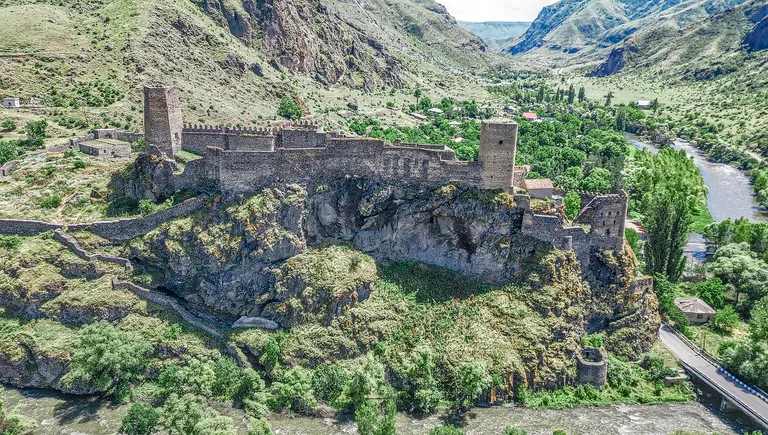
- Khertvisi fortress (16 km) stands at the confluence of the Kura and Paravani rivers and has been mentioned since antiquity. It is visible right from the road, and the climb takes 20-30 minutes.
- Vanis Kvabebi (4 km) - a quiet cave monastery with narrow stairs and a white chapel at the top.
- Rabati fortress in Akhaltsikhe, a large restored citadel where a mosque, a synagogue and a church share one wall. A logical pair with Vardzia for a one-day route.
- Tmogvi - ruins of a fortress above the Kura canyon for those who like scenery without tourists.
If places like this are your thing, have a look at the cave monastery of David Gareja on the border with Azerbaijan as well: another rock-cut complex, founded in the 6th century, set in the semi-desert landscapes of Kakheti.
Tips for Visiting Vardzia
- Come at opening time or after 4 pm: in summer the rocks get hot at midday, and coach groups flow through between 11 am and 3 pm.
- Wear non-slip shoes. The steps in the tunnels are cut into stone and polished by eight centuries of feet, heels and flip-flops have no business here.
- To enter the Church of the Dormition, women need a headscarf and covered shoulders, men need long trousers. Scarves are usually available at the entrance, but your own is safer.
- Bring water and a snack: the cafe is only at the foot of the cliff, and there is nothing up top.
- The best months are May, June, September and October: the Kura valley is green or golden and the sun is gentle. Winter is beautiful and empty, but the days are short.
- Planning an overnight stay - base yourself in Akhaltsikhe, from there it is easy to combine Vardzia, Rabati and Sapara over a day and a half. It is easy to book a hotel in Akhaltsikhe on Booking.com, most places take bookings without prepayment.
If you would rather skip the logistics, take a ready-made tour. At Travel Batumi the routes across southern Georgia are led by certified local guides, and on group trips the driver and the guide are two different people, each doing their own job. All the options are collected on the where to go from Batumi page: destinations from Adjara to Kakheti.
Frequently Asked Questions
How long does a visit to Vardzia take?
On average 1.5-2 hours for the main route. If you want to walk every open tunnel, go down to the spring and take photos without rushing, allow three hours plus the drive.
Can you visit Vardzia with kids?
Yes, children usually love the tunnels and stairs. But the route is not for strollers: steep steps, height changes, low ceilings in places. With preschoolers, hold your child's hand near the open edges, railings are not everywhere.
Is Vardzia an active monastery or a museum?
Both. The complex operates as a museum-reserve, but part of the caves belongs to a working monastery, and services are held in the Church of the Dormition. The monastic area is marked with signs, entry there is not allowed.
Is a one-day trip from Batumi to Vardzia worth it?
Not by public transport: 370 km each way with connections will not fit into a day. With an organized tour it works: the bus leaves early in the morning, the road over the Goderdzi pass is part of the experience in itself, and in one day you see Vardzia, Rabati and mountain Adjara.
When is the best time to visit Vardzia?
From May to October it is warm and the days are long. The most photogenic months are May, June, September and October. In July and August come at opening time: by noon the rocks get hot.
Are there cafes and toilets at Vardzia?
By the ticket office there are toilets, a cafe and a couple of stalls with souvenirs and honey, and a few family restaurants stand along the road by the river. No food or water is sold inside the complex, so bring a bottle of water with you.
Vardzia is one of those places people come back to Georgia for: eight centuries of history carved into a cliff, and not a single dull stretch on the route. Book your tour in advance: in high season the group departures fill up several days ahead.