Rabati fortress in Akhaltsikhe is a rare place in Georgia where an Orthodox church, a mosque, a synagogue and the castle of the princely Jakeli family stand behind a single fortress wall. The complex covers about seven hectares, was rebuilt in 2012, and today it is the main sight of the Samtskhe-Javakheti region together with Vardzia. Here is what to see inside, how much tickets cost in 2026 and how to get there from Batumi, Tbilisi or Borjomi.
Table of contents
Why Rabati Is Worth a Visit
Rabati stands on a hill above Akhaltsikhe, a small town in southern Georgia about 200 km from Tbilisi. The word "rabati" comes from Arabic and means a fortified settlement by a citadel. This place changed hands so many times that its architecture turned into a layer cake: a Georgian citadel, an Ottoman mosque, merchant courtyards, Russian barracks from the 19th century.
The complex got its present look after a large-scale restoration in 2011-2012. The approach was controversial and historians still grumble about the rebuild, but the fortress came back to life: there is a museum, cafes, a hotel and viewing platforms inside, and you can walk the walls for most of the day. There are noticeably fewer tourists here than in Mtskheta or Sighnaghi, and on a weekday the upper courtyard is often all yours.
History: From Lomsia to the Restoration
A settlement on this hill has been known since the 9th century under the name Lomsia. In the 12th century the fortress became the seat of the Jakeli princes who ruled Samtskhe. From the 16th century the region spent three hundred years under the Ottoman Empire: Akhaltsikhe became the center of a pashalik, and the Ahmediye mosque with its gilded dome rose inside the fortress.
In 1828 the fortress was taken by Russian troops under General Paskevich, and Akhaltsikhe joined the Russian Empire. By the end of the 20th century Rabati stood half-abandoned. The restoration of 2011-2012 cost around 34 million GEL and returned the complex to the look of a fortified town: the walls, towers, mosque, Jakeli castle and dozens of buildings between them were rebuilt.
What to See Inside the Fortress
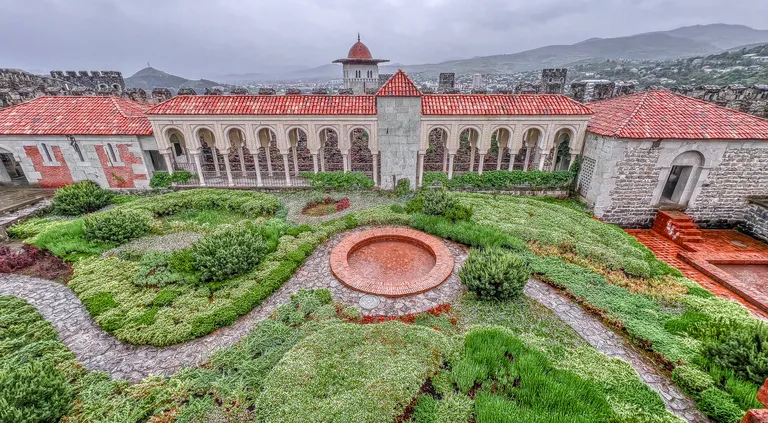
The complex has two parts. The lower one is open to everyone without a ticket: trade rows, an information center, a wine shop, cafes and even a hotel. The upper, historical part is paid, and it is the reason to come.
- The Ahmediye mosque - the main symbol of Rabati. Built in the 18th century after the model of Istanbul mosques, and since the restoration its dome shines gold across the valley.
- Jakeli castle, home to the Samtskhe-Javakheti history museum: archaeology, weapons, carpets, old manuscripts.
- The citadel at the very top. The climb is steep, and the reward is the best panorama around: the tiled roofs of Akhaltsikhe, the Potskhovi river valley and ridges to the horizon.
- An Orthodox church, a synagogue and a madrasa standing within a couple of hundred meters of each other.
- The garden with pools by the mosque, the amphitheater and the "pasha's house" with carved ceilings.
Ticket Prices and Opening Hours in 2026
| Service | Price |
|---|---|
| Lower part of the fortress | free |
| Entrance to the upper part (adult) | 18 GEL |
| Museum in Jakeli castle | 2 GEL |
The upper part is open daily, roughly from 9-10 am to 6 pm, longer in summer; the museum is closed on Mondays. The lower courtyards are accessible around the clock, and in the evening the walls are beautifully lit. Prices are current as of 2026.
How to Get to Rabati Fortress
From Batumi
The road runs through mountainous Adjara and the Goderdzi pass at 2025 meters: about 170 km, but allow 4-5 hours, the switchbacks do not reward hurry. Direct minibuses from Batumi to Akhaltsikhe run several times a day. The easiest option without transfers is a one-day excursion from Batumi to Vardzia and Rabati fortress: in a single day you see both key sights of Samtskhe-Javakheti, and the driver handles the mountain road.
From Tbilisi
About 200 km on a good highway, 3-3.5 hours by car. Minibuses to Akhaltsikhe leave Didube station at intervals of under an hour and cost around 15 GEL. With a car and driver it is easy to combine Rabati with Borjomi and Vardzia: you can check the price of a Tbilisi - Rabati route on GoTrip.ge in advance, and the price per car will not change on the way.
From Borjomi and Bakuriani
This is the closest starting point: Borjomi is 50 km away, minibuses take about an hour. In winter the combination works well: skiing in the morning, the fortress after lunch.
By car
Parking at the entrance is free, and the roads from the Tbilisi and Borjomi side are paved. From the Batumi side over Goderdzi the surface is worse in places, and in winter the pass can close. For an independent route around the region it is convenient to rent a car from local companies via Localrent: pick it up in Batumi or Tbilisi and return it there.
What to See Nearby
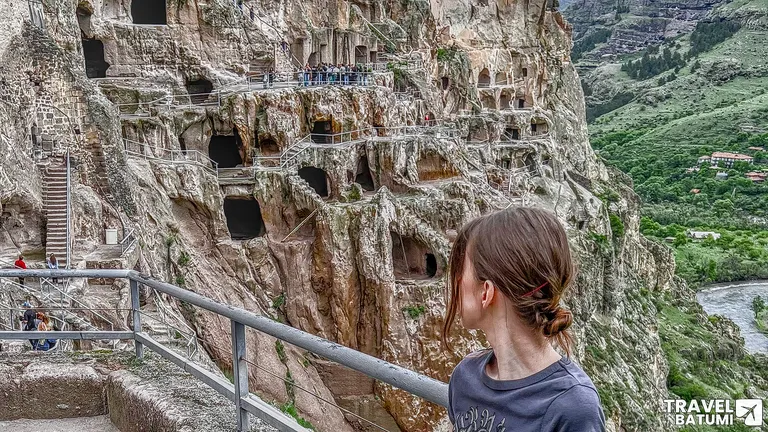
- The cave town of Vardzia, 60 km away: about 600 rooms cut into a cliff and a working 12th-century monastery. A natural pair with Rabati for a one-day route.
- Sapara monastery (12 km) - a 10th-13th century monastery in a gorge that few tourists reach.
- Khertvisi fortress on the road to Vardzia, one of the oldest in the country.
- Borjomi with its mineral springs and park, 50 km from Akhaltsikhe.
Tips for Visiting
- Allow 2-3 hours for the fortress: an hour for the upper part, an hour for the museum, the rest for the citadel and a coffee in the lower courtyard.
- Come at opening time or a couple of hours before sunset. At midday the open courtyards are hot and shade is scarce, while the evening light on the golden dome of the mosque is the best time for photos.
- Wear comfortable shoes: the stairs to the citadel are steep and the stone is slippery after rain.
- Dress modestly for the mosque and the church, and a headscarf will be useful for women.
- If you stay overnight to leave for Vardzia in the morning, it is worth booking a hotel in Akhaltsikhe on Booking.com: there are few options near the fortress and they fill up in summer.
With a guide Rabati opens up better than through museum labels: without the story of the Jakeli and the pashalik these are just handsome walls. Travel Batumi guides are locals who know which tower to shoot the mosque from so the souvenir stalls stay out of the frame. More ideas for day trips are collected on the where to go from Batumi page.
Frequently Asked Questions
Can you visit Rabati fortress for free?
Yes, the lower part with trade rows, cafes and views of the walls is open without a ticket and almost around the clock. You only pay for the upper historical part with the mosque, Jakeli castle and the citadel.
How long does a visit to Rabati take?
At least an hour or an hour and a half for the upper part. With the museum, the citadel and an unhurried coffee in the lower courtyard it comes to 2-3 hours. Photographers should come for the evening light and leave a margin.
Which is better: Rabati or Vardzia?
They are different experiences: Rabati is a restored fortress town with a museum, Vardzia is a monastery carved into a cliff. They are only 60 km apart, so one-day routes usually combine them, and the right answer is both.
Is Rabati worth visiting with kids?
Yes, children have plenty to do here: walls, towers, stairs and a whole town to explore. Watch them on the citadel and the parapets, railings are not everywhere. A stroller will manage the lower courtyards but will struggle higher up.
Is the fortress open in winter?
Yes, the complex is open year-round, and in winter there are hardly any visitors. Just keep in mind the short daylight hours and the fact that the road from Batumi over the Goderdzi pass can be closed in winter: in that season it is safer to come from the Tbilisi or Borjomi side.
Are there cafes and toilets in the fortress?
Yes, the lower part has cafes, a restaurant and toilets, plus a wine shop and souvenir stalls. There is even a hotel on the grounds if you want to meet the sunrise inside the fortress.
Rabati is the case where a fortress is more interesting inside than on a postcard: an hour on the walls replaces a textbook on the history of southern Georgia. Book a tour with a local guide in advance, in high season the group departures fill up several days ahead.