Things to Do in Tbilisi: 20 Top Attractions and Day Trips
Verified: November 2026
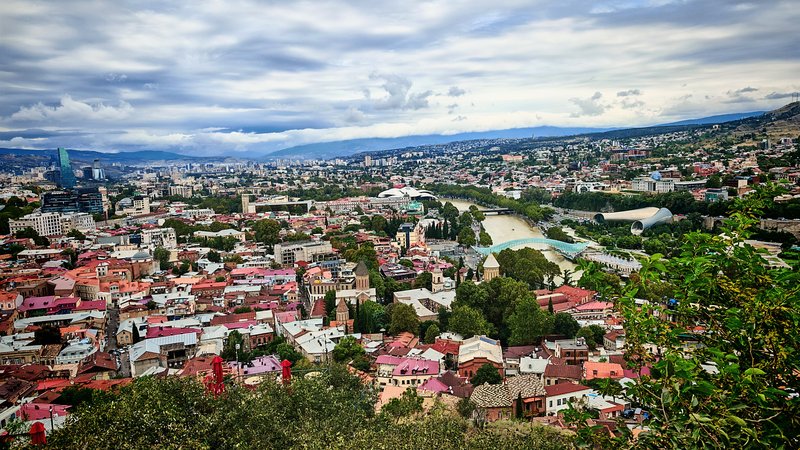
20 sights in the city and nearby: what is free, what the tickets cost, a 1-3 day plan and day trips
Most of what to see in Tbilisi sits along the Mtkvari River: the Old Town with its sulfur baths and the waterfall in the Fig Gorge, the Peace Bridge and Rike Park, the cable car up to Narikala and the Mother of Georgia, Sameba Cathedral, Rustaveli Avenue and Mtatsminda hill with its funicular. Nearly all of it is free and walkable in two or three days. Narikala Fortress has been under restoration since 2024, but the cable car runs and the viewpoints above the Old Town are open. Out of town, people go to Mtskheta, the ancient capital 25 km away, and to Kazbegi via Ananuri Fortress - most easily on a day trip from Tbilisi.
20 sights at a glance
Entry prices are for an adult foreign visitor, as of 2026. Time needed does not include getting there, unless it says otherwise.
| Place | Entry | Time needed |
|---|---|---|
| Old Town Kala and Abanotubani | free | 2-4 h |
| Sioni and Anchiskhati Kala | free, working churches | 30-40 min |
| Narikala and the cable car above the Old Town | cable car 2.5 GEL, fortress closed | about 1 h |
| Mother of Georgia Sololaki hill | free | 30 min |
| Sulfur baths Abanotubani | private room from 130 GEL an hour | 1-2 h |
| Waterfall in the Fig Gorge behind the baths | free | 30 min |
| Metekhi and the Gorgasali statue above the river | free, working church | 30 min |
| Peace Bridge centre | free | 15 min |
| Rike Park left bank | free, balloon up to 60 GEL | about 1 h |
| Sameba Cathedral Avlabari | free, working cathedral | 40-45 min |
| Gabriadze Theatre and clock tower Shavteli Street | shows from 50 GEL | about 1.5 h |
| Freedom Square centre | free | 20 min |
| Rustaveli Avenue and the National Museum centre | museum 40 GEL | 2-3 h |
| Mtatsminda: funicular and park above the centre | park free | 2-3 h |
| Dry Bridge Market centre | free | about 1 h |
| Botanical Garden below Narikala | about 4 GEL | 1.5-2 h |
| Turtle Lake and the Open-Air Museum above Vake | cable car 1 GEL, museum about 20 GEL | half a day |
| Chronicle of Georgia above the Tbilisi Sea | free | about 1 h |
| Mtskheta and Jvari 25 km | free | half a day with the drive |
| Kazbegi and Ananuri 155 km | free, jeep to Gergeti about 25 GEL | a full day |
Everything on this list is open all year. The National Museum and the Open-Air Museum close on Mondays, the cable cars run until 22:00 from 1 November, and Narikala itself is closed for restoration.
Tbilisi on your own in 1, 2 and 3 days
The centre is compact, so plan by riverbanks and hills rather than by the numbers on the list.
Day one is the Old Town. Start at Metekhi Church above the river, walk along the bank to Rike Park, take the cable car up to Narikala and follow the path to the Mother of Georgia. Come down by the steps to Betlemi Street or by the same cable car, then on to Abanotubani: the baths, the Fig Gorge waterfall and Sioni Cathedral. In the evening, walk Shavteli Street with the Gabriadze clock tower and cross the Peace Bridge once it is lit up.
Day two is the newer centre: Freedom Square, Rustaveli Avenue with the Opera and the National Museum, and the Dry Bridge Market, best before lunch. For sunset, go up Mtatsminda: you see the whole city from the hill, then watch it light up.
Day three is for a day trip or a slower pace. Mtskheta and Jvari take half a day, Kazbegi with Ananuri on the way takes a full one. If you stay in town, choose Turtle Lake and the Open-Air Museum, the Botanical Garden or sunset at the Chronicle of Georgia.
Old Town
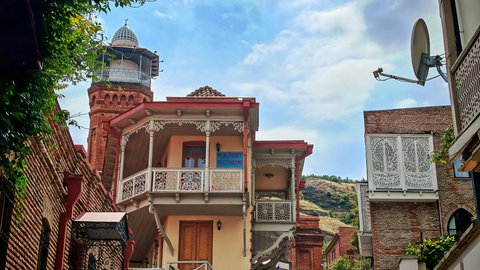
Old Tbilisi is the set of districts below Narikala on the right bank: Kala with its churches and the bars of Erekle II Street, Abanotubani with the baths, and Sololaki with its 19th-century entrance halls. Most buildings are from the 1800s: wooden houses with carved balconies, courtyards with outdoor staircases, brick bath domes and a mosque minaret above them. There are no gates or tickets; the best way to see it is to wander and look into the courtyards.
For your map app, aim for the Abanotubani baths at 41.687655, 44.811481. From the baths it is easy to walk up into Kala and leave over the Peace Bridge to Rike Park.
Sioni and Anchiskhati
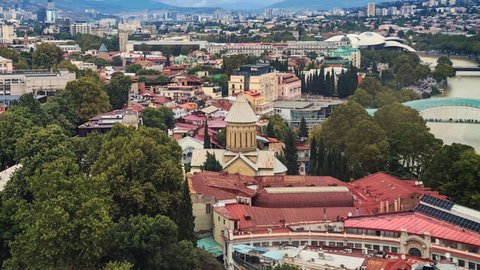
Sioni is the 6th-7th century patriarchal cathedral in Kala, a few hundred metres from the baths. Inside, north of the iconostasis, is the cross of St Nino, the most revered relic of the Georgian Church. Further north, on Shavteli Street next to the Gabriadze Theatre, stands the 6th-century Anchiskhati Basilica, described as the oldest surviving church in the city, though it has been rebuilt more than once.
Both are working churches, so access depends on services. Cover shoulders and knees; women should bring a headscarf. Sioni is at 41.691314, 44.807525.
Narikala Fortress and the cable car
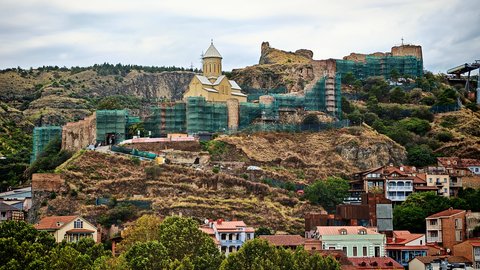
The fortress on the hill above the Old Town has walls dating back to the 4th century, and inside is St Nicholas Church, rebuilt in the 1990s. It has been under restoration since 2024; as of late October 2026 visitors are not allowed inside, and no reopening date has been announced. For the view, that hardly matters: the platforms by the walls and the path to the Mother of Georgia are open, and from here you see the whole Old Town, the river and the Peace Bridge.
The easiest way up is the cable car from Rike Park: about two minutes over the river, 2.5 GEL one way. You pay with a transport card, which costs 2 GEL at the cable car ticket office. From 1 November it runs 10:00-22:00. The fortress is at 41.687729, 44.809111.
Mother of Georgia
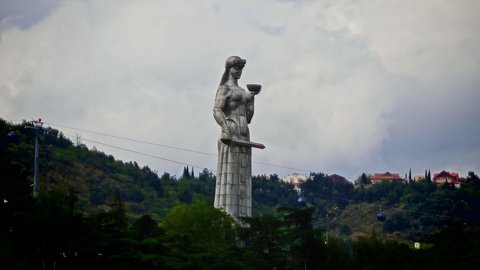
A 20-metre aluminium statue on the ridge of Sololaki hill, put up in 1958 for Tbilisi's 1,500th anniversary. In one hand she holds a bowl of wine for guests, in the other a sword for enemies. It is about five minutes' walk along the path from Narikala, with a different view: the roofs of Sololaki and Mtatsminda hill.
Go up by the cable car from Rike Park or by the steps from Betlemi Street; morning or late afternoon is the best time. Coordinates: 41.688120, 44.804603.
Abanotubani sulfur baths
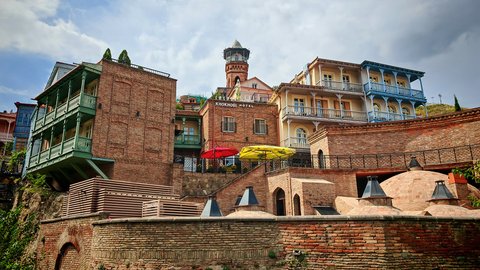
A quarter of brick domes below Narikala where hot sulfur water rises from the ground. You book a private room with a pool for an hour or two, for a couple, a family or a group, and pay per room, not per person: at Chreli Abano from 130 GEL an hour, at Royal Bath from 150 GEL (2026 prices). Soap, towels and a kisa scrub with a coarse mitten cost extra.
Evenings and weekends book up, and Chreli Abano does not take online bookings for the same day. Which bath to choose and how to book a room is on our page about the Tbilisi sulfur baths.
Waterfall in the Fig Gorge
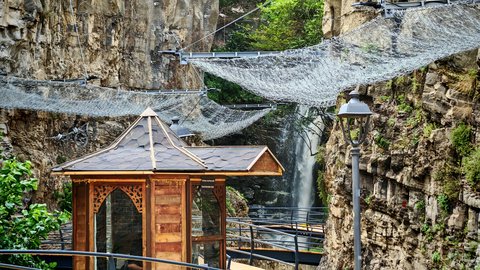
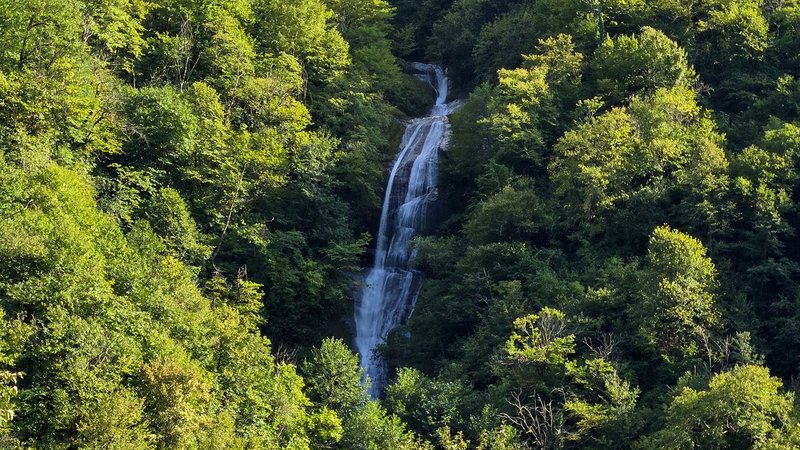
Right behind the baths the street turns into the narrow Leghvtakhevi gorge: a path between the cliffs, small bridges, cafe terraces and a waterfall about 22 metres high. It is a half-hour city walk rather than wild nature. In the evening street lamps light up the waterfall, which is the best time for photos.
Entry is free. From the baths, walk along Abano Street into the gorge; the waterfall is at 41.687090, 44.811050. Further up the gorge is the Botanical Garden.
Metekhi Church and the Gorgasali statue
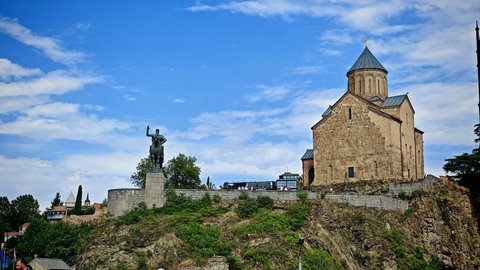
A 13th-century church on a cliff above the river, opposite the baths, and one of the best-known views of Tbilisi. Tradition says the first church here was built by King Vakhtang Gorgasali, the founder of the city; his equestrian statue stands next to it at the cliff edge. In the 19th century the fortress here became a prison, and services in the church only resumed in 1988.
From here you look across to Abanotubani and Narikala, and Rike Park and the Peace Bridge are a few minutes' walk away. Coordinates: 41.690152, 44.811248.
Peace Bridge
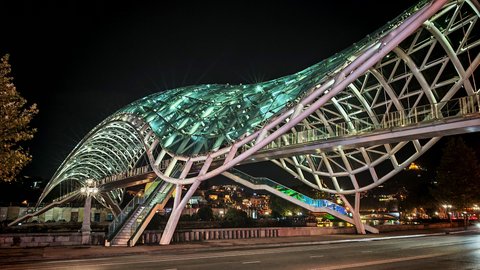
A 150-metre pedestrian bridge of glass and steel, opened in 2010 between the Old Town and Rike Park. By day it looks like a clear wave over the river, but come at dusk: the lights go on an hour and a half before sunset, run along the roof, and sensors in the railings light up wherever someone walks.
Entry is free. What the lights mean and where to take the best photo is on our page about the Peace Bridge in Tbilisi. Most Old Town walking tours cross it.
Rike Park
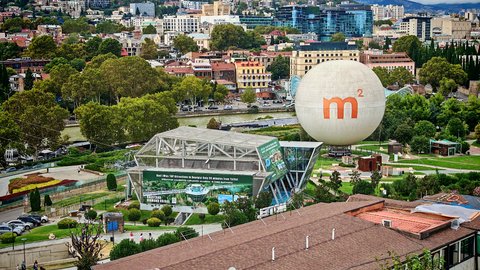
A park on the left bank by the Peace Bridge, with paths between clipped hedges, an amphitheatre, a fountain, playgrounds, a concert hall made of two glass tubes and a piece of the Berlin Wall. The cable car to Narikala leaves from here, and a tethered balloon rises above the park.
The park is free. The balloon ride costs up to 60 GEL for foreign visitors and does not fly in wind or rain. Coordinates: 41.693199, 44.809987.
Sameba Cathedral
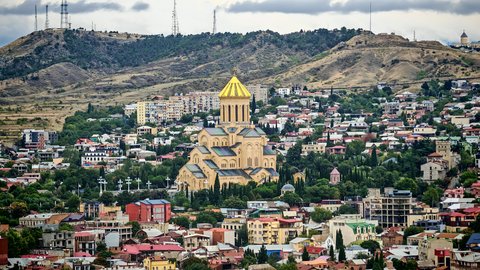
Georgia's main cathedral, on Elia hill in the Avlabari district: consecrated in 2004, 86.1 metres high including the cross, with nine churches and chapels under one roof, some of them underground. Its golden dome is visible from almost anywhere in the centre, and it is lit up at night.
Walk from the Old Town over the Metekhi bridge or from Avlabari metro station. It is a working cathedral: cover shoulders and knees, women wear a headscarf; check the rules at the door. Coordinates: 41.697548, 44.816522.
Gabriadze Theatre and the clock tower
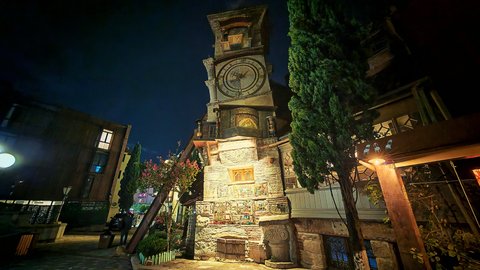
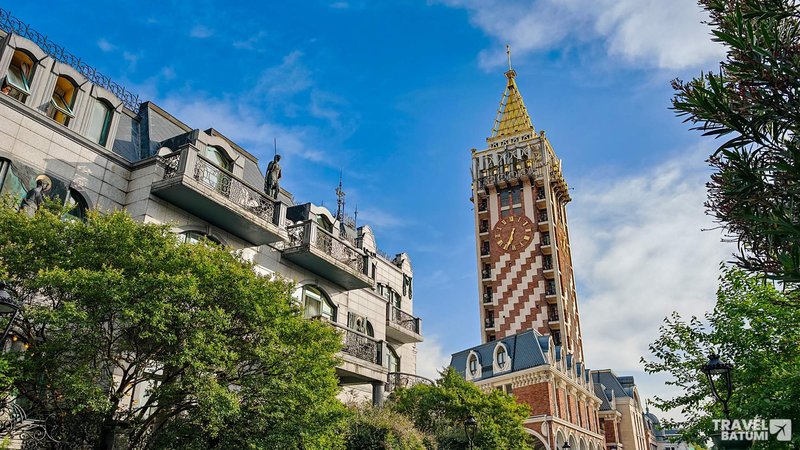
A puppet theatre for adults at 13 Shavteli Street, with a leaning clock tower by the entrance. Every hour an angel comes out of a little door to strike the bell, and at 12:00 and 19:00 a puppet show called the Circle of Life plays under the clock - you watch it from the street.
Performances start at 16:00 or 19:00, tickets are from 50 GEL, children under 12 are not admitted, and the last seats for evening shows sell for more. Programme and tickets are on our page about the Gabriadze Theatre.
Freedom Square
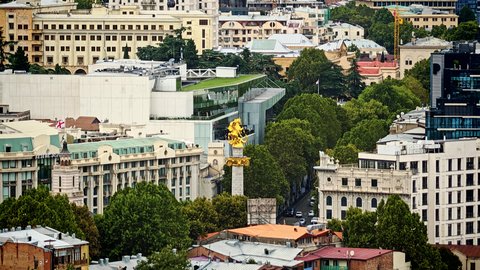
The central square where Rustaveli Avenue begins. Above it rises a 40-metre column with a golden St George by Zurab Tsereteli, put up in 2006; a Lenin monument once stood here. Around it is the 19th-century Caucasus Army headquarters, and below it the Freedom Square metro station.
A handy starting point: the Old Town is one way, Rustaveli the other. Coordinates: 41.693517, 44.801535.
Rustaveli Avenue and the National Museum
The main avenue runs north-west from Freedom Square past the Opera in its 1896 building, the Rustaveli Theatre, the National Gallery, Parliament and Kashveti Church with murals by Lado Gudiashvili. Walking it is free, and on a rainy day the main stop is the National Museum at 3 Rustaveli Avenue: Georgian archaeology from the Stone Age and an exhibition on the Soviet occupation of 1921-1991.
The museum opens Tuesday to Sunday, 10:00-18:00, last entry 17:30. A ticket for foreign visitors is 40 GEL, but sources differ, so check at the ticket office. Coordinates: 41.696043, 44.800221.
Mtatsminda: funicular and park
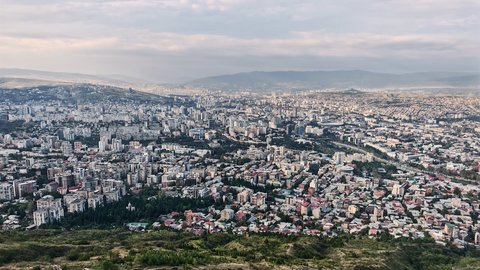
The highest point of Tbilisi, about 770 metres: an amusement park with a 65-metre Ferris wheel and the TV tower you can see from every district. A funicular climbs from Chonkadze Street in about five minutes. On the slope below the park is the pantheon at Mamadaviti Church, where Griboyedov and Chavchavadze are buried.
The park is free; you pay for the funicular and rides with a park card sold at the ticket office. The funicular runs daily 11:00-22:30, the Ferris wheel until about 21:00. Come for sunset. Coordinates: 41.693040, 44.779477.
Dry Bridge Market
A flea market on the Dry Bridge and in the little park next to it: over a hundred sellers with Soviet badges and coins, enamel, silver and tableware, plus paintings by local artists in the park. Haggling is expected, sellers take cash, and nobody guarantees that antiques are genuine.
The market runs daily; come before lunch, as some sellers stay home when it rains. It is about ten minutes' walk from Freedom Square, at 41.700505, 44.802592.
Botanical Garden
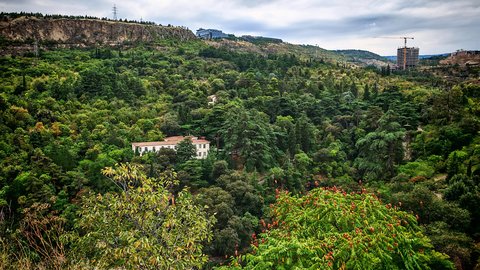
A garden in the gorge below Narikala that was a royal garden until 1845: shady paths, small bridges over the stream and quiet a few minutes from the baths. Only part of it is open to visitors, but that is plenty for a two-hour walk.
The entrance is at the end of Botanical Street, and tickets are about 4 GEL according to travel guides, as the garden's website is being updated. From October to March it opens 9:00-17:30, longer in summer. Coordinates: 41.685066, 44.802658.
Turtle Lake and the Open-Air Museum
A small lake on the slope above the Vake district, reached in six minutes by the cable car from Vake Park, about 1 GEL one way. Forest and trails to viewpoints surround it, and further along the slope is the Open-Air Museum of Ethnography: dozens of old houses, barns and wine cellars from different regions of Georgia, many with their own attendant.
The museum opens Tuesday to Sunday; tickets are about 20 GEL, though there is no official price and sources differ. Expect a lot of walking on the slope and wear good shoes. The cable car runs 10:00-22:00. The museum is at 41.701870, 44.743581.
Chronicle of Georgia
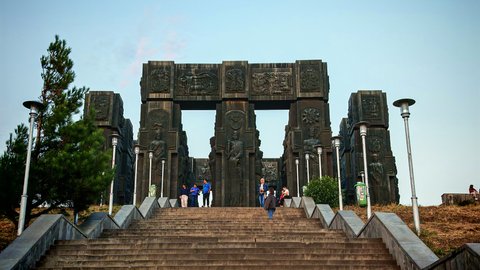
Sixteen pillars 30-35 metres tall on a hill above the Tbilisi Sea: kings, queens and heroes of Georgia at the top, scenes from the life of Christ below. Zurab Tsereteli began the monument in 1985, and up close you can make out every crown and scroll. Entry is free, and at sunset the steps look out over all of Tbilisi to the mountains.
The monument is on the edge of the city. How to get there and what to look for on the pillars is on our page about the Chronicle of Georgia.
Mtskheta and Jvari Monastery
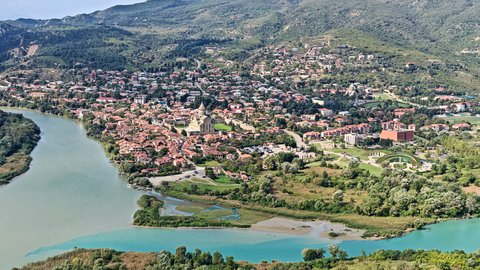
The ancient capital of Georgia, 25 km from Tbilisi where the Aragvi meets the Mtkvari. Its three churches - Svetitskhoveli Cathedral and the Jvari and Samtavro monasteries - have been a UNESCO World Heritage Site since 1994. Svetitskhoveli was built in 1010-1029 and is still the country's main church, surrounded by cobbled streets with cafes and souvenir stalls. Jvari stands on the hill across the river: below it the turquoise Aragvi meets the muddier Mtkvari, with the red roofs of Mtskheta between them.
Entry to the churches is free, and half a day covers it all. Svetitskhoveli and Samtavro are within walking distance; Jvari is a taxi ride. More on Mtskheta and Jvari Monastery on their own pages.
Kazbegi and Ananuri Fortress
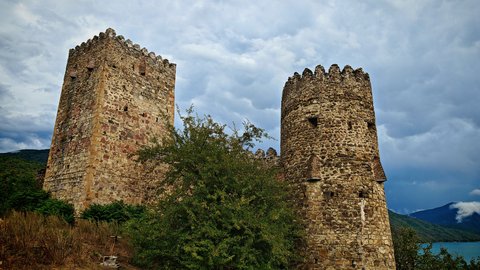
The most popular day trip from Tbilisi follows the Georgian Military Road to Mount Kazbek. After 70 km comes 17th-century Ananuri Fortress above the Zhinvali Reservoir, then the pass near Gudauri and, 155 km from the city, Stepantsminda. Above the town at 2,170 metres stands the 14th-century Gergeti Trinity Church, with Kazbek behind it on a clear day.
It is 3-3.5 hours each way by car, so plan a full day. People go up to Gergeti by jeep, about 25 GEL per person, or walk up in an hour to an hour and a half. Without a tour, you can book a private car with a driver to Kazbegi on GoTrip and stop wherever you like. What to see in the town is on our page about Kazbegi, and the fortress has its own page on Ananuri.
Tours in Tbilisi and day trips
A guide opens up what a list cannot: the stories of Sololaki courtyards, the baths and the balconies. Our own tours start in Batumi, so for Tbilisi we suggest English-speaking tours with traveller reviews: Old Town walks, Mtskheta, Kazbegi, Kakheti and the glass bridge over Dashbashi Canyon, 103 km from the city.
Where to stay and what to sort out
The easiest bases are the Old Town, Sololaki and Avlabari, as almost everything on this list is within walking distance. The districts are compared in our guide to where to stay in Tbilisi, and getting into town is covered on our page about Tbilisi Airport.
Find a hotel in Tbilisi on Booking.com
The coordinates in this guide work best with mobile data: an Airalo eSIM for Georgia can be set up before you fly.
Travel insurance has been compulsory for entering Georgia since 2026, and you can get a policy online on Polis.ge, even once you are in Georgia. What the policy needs to cover is in our guide to travel insurance for Georgia.
Frequently asked questions
What can I see in Tbilisi in one day?
The Old Town: Metekhi, Rike Park, the cable car to Narikala and the Mother of Georgia, the baths and the Fig Gorge waterfall, and the Peace Bridge lit up in the evening. It is all walkable; if you still have energy, go up Mtatsminda for sunset.
Can I visit Narikala Fortress?
As of late October 2026 the fortress is closed for restoration, which started in 2024, and no reopening date has been announced. The cable car runs, and the viewpoints by the walls and the path to the Mother of Georgia are open.
Which Tbilisi attractions are free?
The Old Town, the Peace Bridge, Rike Park, Freedom Square and Rustaveli Avenue, the Fig Gorge waterfall, the Mother of Georgia, the Chronicle of Georgia and the churches - Sioni, Metekhi and Sameba. Mtatsminda Park is free too; you only pay for the funicular and rides. Museums, the baths, the Botanical Garden, cable cars and shows need tickets.
What is there to do in Tbilisi with kids?
Mtatsminda Park with its rides and Ferris wheel, the cable car from Rike Park and Turtle Lake with the Open-Air Museum. Children under 12 are not allowed into the Gabriadze Theatre, but the whole family can watch the puppet show on the clock tower at 12:00 and 19:00.
What to do in Tbilisi when it rains?
Visit the National Museum on Rustaveli Avenue (closed on Mondays), book a sulfur bath or see a show at the Gabriadze Theatre. The cable cars may stop in strong wind and rain.
What is worth seeing around Tbilisi?
The closest is Mtskheta with Jvari Monastery, 25 km and half a day. For a full day, people go to Kazbegi via Ananuri, to Kakheti for wine and to the glass bridge over Dashbashi Canyon.
Written and checked by the Travel Batumi team →